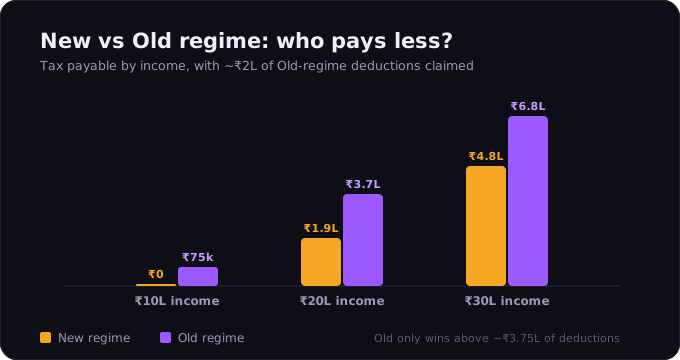
Every year, the question comes up: should you stick with the Old Regime or switch to the New Regime? For FY 2026-27, the answer has shifted significantly — the New Regime has become more attractive for most salaried individuals, and the government has made it the default. But "default" doesn't always mean "better for you." This guide walks through everything you need to know.
What Changed in Budget 2025?
The Union Budget 2025 overhauled the New Regime's tax slabs substantially. The biggest headline: if your taxable income is ₹12 lakh or less under the New Regime, you pay zero tax — because of an enhanced Section 87A rebate of ₹60,000. The standard deduction for salaried employees was also raised to ₹75,000, so a salaried person with a gross salary up to ₹12.75 lakh effectively pays no income tax under the New Regime.
New Regime Tax Slabs — FY 2026-27
The New Regime (now the default under Section 115BAC) uses these slabs:
New Regime Slabs (FY 2026-27)
| Income Slab | Rate |
|---|---|
| ₹0 – ₹4,00,000 | 0% |
| ₹4,00,001 – ₹8,00,000 | 5% |
| ₹8,00,001 – ₹12,00,000 | 10% |
| ₹12,00,001 – ₹16,00,000 | 15% |
| ₹16,00,001 – ₹20,00,000 | 20% |
| ₹20,00,001 – ₹24,00,000 | 25% |
| Above ₹24,00,000 | 30% |
Plus: Standard deduction ₹75,000 for salaried. Section 87A rebate up to ₹60,000 if taxable income ≤ ₹12L. Health & Education Cess 4% on total tax.
Old Regime Tax Slabs — FY 2026-27
Old Regime Slabs (FY 2026-27)
| Income Slab | Rate |
|---|---|
| ₹0 – ₹2,50,000 | 0% |
| ₹2,50,001 – ₹5,00,000 | 5% |
| ₹5,00,001 – ₹10,00,000 | 20% |
| Above ₹10,00,000 | 30% |
Standard deduction: ₹50,000. 87A rebate: ₹12,500 if taxable income ≤ ₹5L. Allows 80C, 80D, HRA, and many other deductions.
Section 87A Rebate — The Most Important Number
The Section 87A rebate is the single biggest driver of which regime is better. Here's how it works:
- New Regime: If your net taxable income (after standard deduction) is ₹12 lakh or less, you get a rebate equal to your entire tax liability — up to ₹60,000. You pay zero tax.
- Old Regime: If your net taxable income is ₹5 lakh or less, your tax liability is zero (rebate up to ₹12,500).
Crucially, the rebate is a cliff — it doesn't taper. If your New Regime taxable income is ₹12,00,001 (just ₹1 over), you suddenly owe full tax on the entire ₹12L, not just on ₹1. This is why you'll hear about people trying to stay just under the limit.
Surcharge
Surcharge applies on top of income tax for high earners, before the cess is added:
- ₹50L – ₹1Cr: 10%
- ₹1Cr – ₹2Cr: 15%
- ₹2Cr – ₹5Cr: 25%
- Above ₹5Cr: 25% (New Regime); 37% (Old Regime)
The surcharge cap at 25% in the New Regime is a meaningful benefit for very high earners — under the Old Regime, the 37% surcharge on income above ₹5 crore creates an eye-watering effective rate.
Health & Education Cess (4%)
After calculating income tax and adding any surcharge, you pay 4% on the total as Health & Education Cess. This applies to everyone regardless of income. No deduction reduces it.
Worked Examples — Five Income Levels
Example 1 — ₹8 Lakh Gross Salary (Salaried)
New Regime: ₹8L − ₹75K std deduction = ₹7.25L taxable. Tax on ₹7.25L: ₹0 (0–4L) + ₹20,000 (5% on 4–7.25L) = ₹20,000. Since taxable income < ₹12L → 87A rebate = ₹20,000. Tax = ₹0.
Old Regime (no deductions): ₹8L − ₹50K = ₹7.5L taxable. Tax: ₹0 + ₹12,500 + ₹50,000 = ₹62,500. Cess: ₹2,500. Total: ₹65,000.
New Regime saves ₹65,000.
Example 2 — ₹12 Lakh Gross Salary (Salaried)
New Regime: ₹12L − ₹75K = ₹11.25L taxable. Tax: ₹0 + ₹20,000 + ₹32,500 = ₹52,500. Since taxable ≤ ₹12L → 87A rebate = ₹52,500. Tax = ₹0.
Old Regime (80C ₹1.5L + 80D ₹25K): ₹12L − ₹50K − ₹1.5L − ₹25K = ₹9.75L taxable. Tax: ₹12,500 + ₹95,000 = ₹1,07,500. Cess: ₹4,300. Total: ₹1,11,800.
New Regime saves ₹1,11,800.
Example 3 — ₹15 Lakh Gross Salary (Salaried)
New Regime: ₹15L − ₹75K = ₹14.25L taxable. Tax: ₹20,000 + ₹40,000 + ₹33,750 = ₹93,750. Cess 4%: ₹3,750. Total: ₹97,500.
Old Regime (80C ₹1.5L + 80D ₹25K + HRA ₹1L): ₹15L − ₹50K − ₹1.5L − ₹25K − ₹1L = ₹11.75L taxable. Tax: ₹12,500 + ₹1,35,000 = ₹1,47,500. Cess: ₹5,900. Total: ₹1,53,400.
New Regime saves ₹55,900 — even with deductions.
Example 4 — ₹25 Lakh Gross Salary (Salaried)
New Regime: ₹25L − ₹75K = ₹24.25L taxable. Tax: ₹20K + ₹40K + ₹60K + ₹80K + ₹80K + ₹6,250 = ₹2,86,250. Cess: ₹11,450. Total: ₹2,97,700.
Old Regime (max deductions ₹2.5L): ₹25L − ₹50K − ₹2.5L = ₹22L taxable. Tax: ₹12,500 + ₹1,00,000 + ₹3,60,000 = ₹4,72,500. Cess: ₹18,900. Total: ₹4,91,400.
New Regime saves ₹1,93,700.
Example 5 — ₹1 Crore Gross Income (Business)
New Regime: No standard deduction for business. ₹1Cr taxable. Tax at slabs: ₹20K + ₹40K + ₹60K + ₹80K + ₹80K + ₹2,28,000 = ₹17,28,000 approx (rough calc). Surcharge 10% (income ₹50L–₹1Cr): Add ₹1,72,800. Cess 4%: ₹75,992. Total ~₹19,76,792.
At high incomes, always compare both regimes carefully. Use our calculator for precise figures.
When Does the Old Regime Still Win?
The Old Regime can still be better if you have very high deductions. The break-even point where Old Regime becomes better than New Regime (for a salaried person) is roughly:
- Income ₹15–20L: Old Regime needs deductions of ~₹3.75L+ to beat New Regime
- Income ₹20–30L: Needs ~₹4–5L in deductions
- Income above ₹30L: Old Regime rarely wins — the New Regime's lower top rates and surcharge cap make it hard to overcome
Business owners and professionals get no standard deduction under the New Regime, which changes the calculation. If you have significant business expenses, home loan interest (for let-out property), or multiple investments, always run both numbers.
Key Deductions Available Only Under Old Regime
- Section 80C — PF, PPF, ELSS, LIC, NSC, home loan principal, children's tuition. Max ₹1,50,000.
- Section 80D — Health insurance premiums. ₹25,000 for self/family; ₹25,000 (₹50,000 for senior citizens) for parents.
- HRA — House Rent Allowance exemption. Actual HRA received, or 50%/40% of basic (metro/non-metro), or (rent paid − 10% basic), whichever is lowest.
- Section 24(b) — Home loan interest up to ₹2L (self-occupied property).
- LTA — Leave Travel Allowance exemption.
- Standard deduction — ₹50,000 (vs ₹75,000 in New Regime).
Calculate your exact tax in seconds
Enter your salary once — our calculator shows Old vs New regime side by side, names the winner, and gives you the full bracket breakdown including rebate, surcharge and cess.
Open Income Tax Calculator →Frequently Asked Questions
Data sources: Income Tax Department India (incometax.gov.in), Finance Act 2025, Union Budget 2025 memorandum. Tax Year: FY 2026-27 (Tax Year 2026-27). This guide is for educational purposes. Individual circumstances vary — consult a chartered accountant for personal tax advice.
Official sources
Every rate and threshold in this guide is checked against the official government sources below. Always confirm figures for your own situation before filing.