GST (Goods and Services Tax) replaced a complex web of Central Excise, VAT, Service Tax, and a dozen other indirect taxes in July 2017. It's a destination-based tax, meaning tax is collected where goods or services are consumed. India runs a dual GST structure — CGST (Central GST) and SGST (State GST) — which are collected simultaneously at equal rates. For inter-state transactions, IGST (Integrated GST) applies.
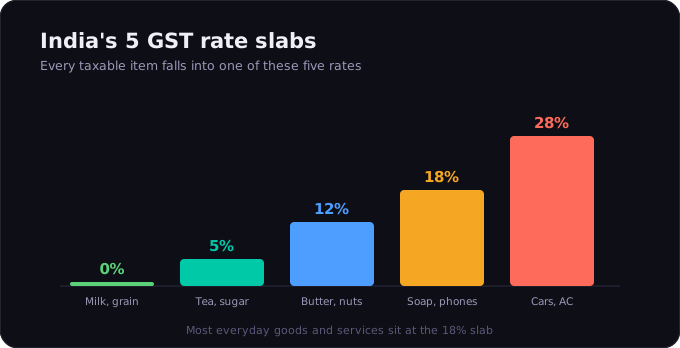
The Five GST Rate Slabs
| Rate | What's Covered |
|---|---|
| 0% | Essential food items (rice, wheat, milk, eggs, fresh vegetables, fruits), books, newspapers, healthcare services, education |
| 5% | Packaged food, tea, coffee, coal, fertilisers, economy hotels (room tariff under ₹7,500), economy-class air travel, transport services |
| 12% | Butter, ghee, fruit juices, mobile phones, business-class air travel, hotels (₹7,500–₹12,500), work contracts |
| 18% | Most services (telecom, IT services, banking, insurance, restaurants without alcohol licence), electronics, stationery, mineral water, ice cream, haircare products, luxury hotels (above ₹12,500) |
| 28% | Luxury/sin goods — cars, motorcycles, cement, tobacco, aerated drinks, casinos, online gaming, large consumer durables (ACs, dishwashers) |
Beyond 28%, some goods attract an additional Compensation Cess — for example, cigarettes, luxury cars above ₹10L, and aerated drinks carry cess on top of the 28% GST.
CGST vs SGST vs IGST
When you buy something within your state (intra-state), the 18% GST is split as 9% CGST (goes to Central govt) + 9% SGST (goes to State govt). When buying across states (inter-state), the full 18% is collected as IGST and then apportioned. As a consumer, this split doesn't affect you — you pay the same percentage either way.
How to Add GST to a Price (Exclusive → Inclusive)
If you know the price before GST (base price) and want to find the final price including GST:
Formula: Final Price = Base Price × (1 + GST Rate/100)
Example: Laptop base price ₹50,000. GST rate 18%.
₹50,000 × (1 + 18/100) = ₹50,000 × 1.18 = ₹59,000
GST amount = ₹9,000 (CGST ₹4,500 + SGST ₹4,500)
How to Remove GST from a GST-Inclusive Price (Inclusive → Exclusive)
If a price already includes GST and you want to find the pre-GST base price or the GST component:
Formula: Base Price = Inclusive Price ÷ (1 + GST Rate/100)
Example: Restaurant bill ₹2,360 including 18% GST.
₹2,360 ÷ 1.18 = ₹2,000 (base price)
GST amount = ₹2,360 − ₹2,000 = ₹360
A common mistake: people incorrectly calculate 18% of ₹2,360 = ₹424.80. That gives a wrong answer — you must divide, not multiply.
Common GST Examples by Category
| Item | GST Rate |
|---|---|
| Fresh vegetables, fruits | 0% |
| Branded packaged food | 5% |
| Restaurant (non-AC, no alcohol) | 5% |
| Restaurant (AC / full-service) | 18% |
| Smartphone | 18% |
| Laptop / Computer | 18% |
| Clothes (below ₹1,000) | 5% |
| Clothes (above ₹1,000) | 12% |
| Gold (jewellery) | 3% |
| Petrol, Diesel | Not under GST |
| Air conditioner | 28% |
| Car (above 4m, > 1500cc) | 28% + cess |
GST on Real Estate
Under-construction properties attract 5% GST (1% for affordable housing, defined as price under ₹45L and carpet area under 60 sqm in metro / 90 sqm in non-metro). Completed, ready-to-move properties with a completion certificate do not attract GST — which is why developers hurry to get completion certificates before handing over.
Input Tax Credit (ITC)
Registered businesses can claim credit for GST they paid on inputs (raw materials, services) against the GST they collect from customers. This "input tax credit" prevents cascading taxation. As an end consumer, you don't claim ITC — you bear the full burden of GST. But businesses in the supply chain don't pay tax on the same value multiple times.
GST Registration Threshold
Businesses with annual turnover above ₹40 lakh (goods) or ₹20 lakh (services) must register for GST. In special category states (hilly, north-eastern), the threshold is ₹10 lakh. E-commerce operators must register regardless of turnover.
Calculate GST instantly
Add GST to a price or remove GST from a GST-inclusive amount — works for all five rate slabs.
Open GST Calculator →Frequently Asked Questions
Source: GST Council, cbic.gov.in. Rates current as of 2025. GST rates on specific goods and services are subject to revision by the GST Council. Not financial or tax advice.
Official sources
Every rate and threshold in this guide is checked against the official government sources below. Always confirm figures for your own situation before filing.