Every home loan, car loan, personal loan, and EMI scheme uses the same core mathematics. Understanding it gives you real power: you can compare loans correctly, estimate prepayment savings instantly, and see through "low EMI" marketing tactics that hide the true cost. This guide explains the reducing balance EMI formula from first principles.
What Is EMI?
An Equated Monthly Instalment (EMI) is a fixed payment made each month for the entire loan tenure. "Equated" means the amount stays the same every month — but what changes month by month is the split between interest and principal inside that fixed payment.
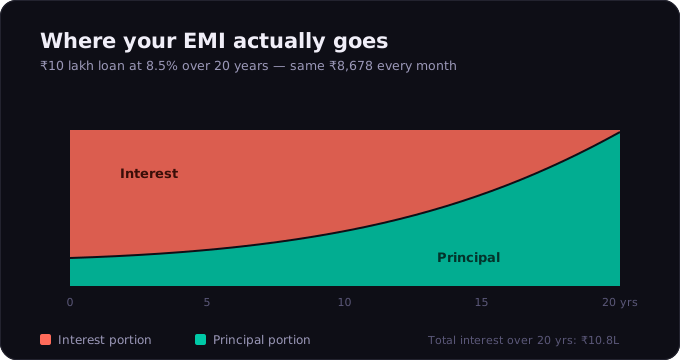
Early in the loan, most of your EMI goes toward interest. Later, the principal share grows. This is the essence of amortisation.
The EMI Formula
The reducing balance (flat-rate equivalent) formula:
- P = Principal (loan amount)
- r = Monthly interest rate = Annual rate ÷ 12 ÷ 100
- n = Total number of monthly instalments (years × 12)
Worked Example — ₹30 Lakh Home Loan
Loan: ₹30,00,000 | Rate: 8.5% p.a. | Tenure: 20 years
P = 30,00,000
r = 8.5 / 12 / 100 = 0.007083
n = 20 × 12 = 240
(1+r)ⁿ = (1.007083)²⁴⁰ ≈ 5.392
EMI = 30,00,000 × (0.007083 × 5.392) / (5.392 − 1)
EMI = 30,00,000 × 0.03820 / 4.392
EMI ≈ ₹26,085 / month
Total paid = ₹26,085 × 240 = ₹62,60,400
Total interest = ₹62,60,400 − ₹30,00,000 = ₹32,60,400 — more than the loan itself!
How Amortisation Works Month by Month
Here's how the first three months of the above loan break down:
| Month | Opening Balance | Interest | Principal | Closing |
|---|---|---|---|---|
| 1 | ₹30,00,000 | ₹21,250 | ₹4,835 | ₹29,95,165 |
| 2 | ₹29,95,165 | ₹21,216 | ₹4,869 | ₹29,90,296 |
| 3 | ₹29,90,296 | ₹21,181 | ₹4,904 | ₹29,85,392 |
Notice: each month the interest falls slightly (balance is lower) and the principal rises by the same amount. The EMI stays constant at ₹26,085.
The Two-Variable Sensitivity: Rate vs Tenure
For the same ₹30 lakh loan, here's how rate and tenure interact:
| Rate | 10 years EMI | 20 years EMI | 30 years EMI |
|---|---|---|---|
| 7% | ₹34,833 | ₹23,259 | ₹19,960 |
| 8.5% | ₹37,196 | ₹26,085 | ₹23,076 |
| 10% | ₹39,645 | ₹28,951 | ₹26,322 |
Key insight: going from 20 to 30 years at 8.5% saves only ₹3,009/month in EMI but costs ₹22.7 lakh extra in total interest.
Prepayment: The Most Powerful Lever
Making a lump-sum prepayment reduces your outstanding principal — which directly reduces the interest calculated for every future month. The savings are not linear; they're exponential near the beginning of the loan because you eliminate interest that would have compounded for decades.
Scenario: ₹30L loan, 8.5%, 20 years. After 1 year (12 EMIs paid), make a ₹3 lakh prepayment.
Outstanding balance after 12 months: ~₹29,42,000
After ₹3L prepayment: ~₹26,42,000 new balance.
At same EMI, loan closes ~2.5 years early.
Interest saved: ~₹7–8 lakh — roughly 2.5× the prepayment amount.
Flat Rate vs Reducing Balance: The Hidden Difference
Some lenders (particularly personal loan and consumer finance companies) quote a "flat rate." A 6% flat rate sounds cheaper than an 8.5% reducing balance rate — but it's not:
- Flat rate: Interest = Principal × Rate × Years. Charged on original principal every month regardless of repayments. Total interest on ₹10L at 6% flat for 3 years = ₹10L × 6% × 3 = ₹1,80,000.
- Reducing balance: Interest is charged only on the outstanding balance, which falls each month. Total interest on ₹10L at 10.9% reducing for 3 years ≈ ₹1,80,000.
A flat rate of 6% is approximately equivalent to a reducing balance rate of ~11%. Always ask lenders: "What is the effective annual rate (EAR) on a reducing balance basis?"
Calculate your EMI and see the full amortisation table
Open EMI Calculator →Mathematical examples are illustrative. Actual interest calculations may vary by lender's day-count convention. Not financial advice.
Official sources
Every rate and threshold in this guide is checked against the official government sources below. Always confirm figures for your own situation before filing.